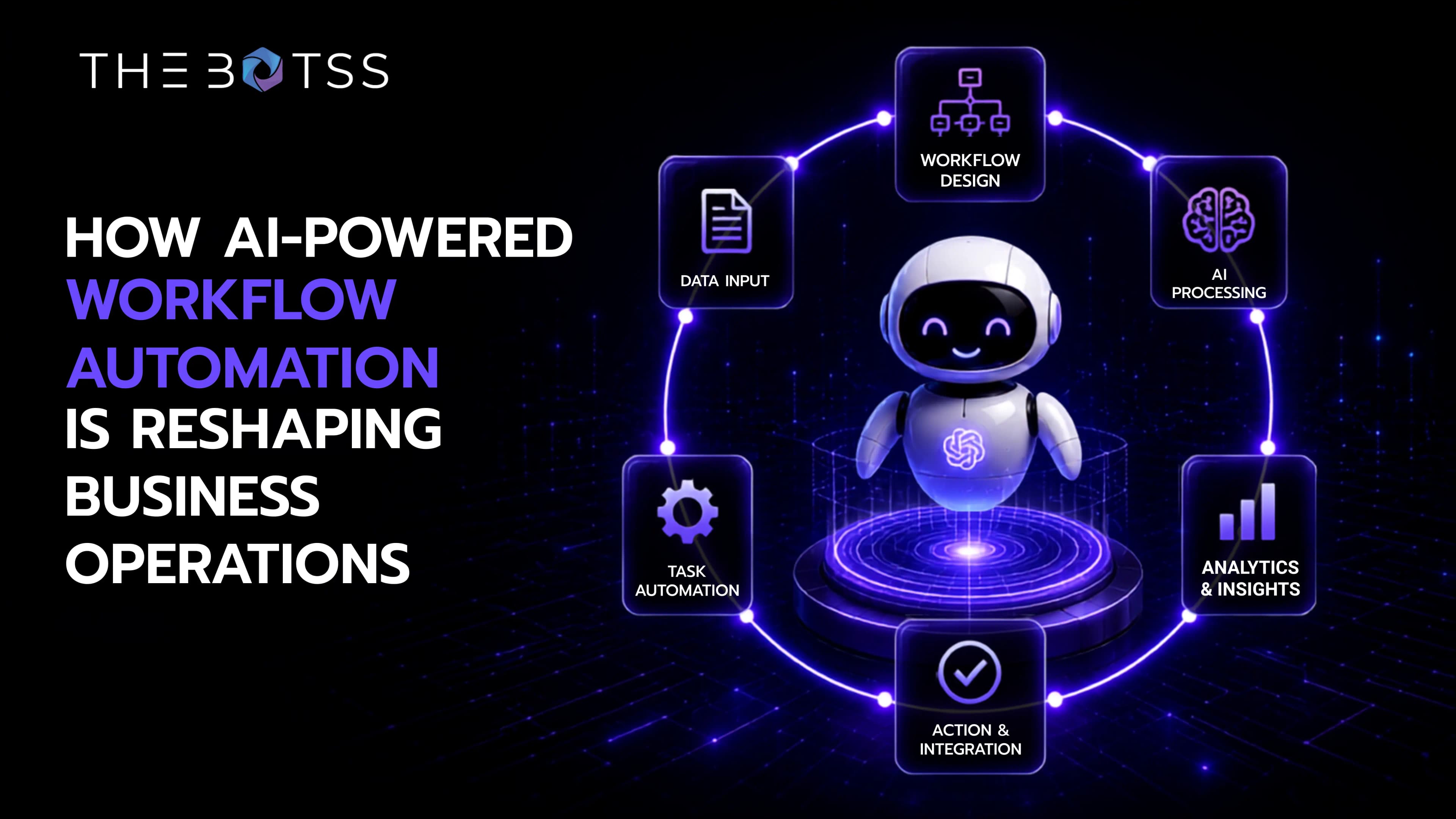
Artificial intelligence has evolved from a futuristic concept into a practical business tool that is transforming the way organizations operate. Companies across industries are embracing intelligent technologies to improve efficiency, reduce operational costs, and deliver better customer experiences. One of the most significant advancements driving this transformation is AI-powered workflow automation. By combining artificial intelligence with workflow management, businesses can automate repetitive tasks, make smarter decisions, and streamline complex business processes with minimal human intervention. Unlike traditional automation, which follows predefined rules, AI-powered automation can analyze data, learn from patterns, predict outcomes, and continuously improve its performance over time. Whether it is processing invoices, handling customer service requests, managing employee onboarding, optimizing supply chains, or delivering AI-powered services across business functions, AI is helping organizations work faster and smarter. As digital transformation continues to accelerate, businesses that invest in intelligent automation gain a competitive advantage by increasing productivity while allowing employees to focus on strategic and creative responsibilities.
Understanding AI-Powered Workflow Automation
At its core, AI-powered workflow automation refers to the use of artificial intelligence technologies to automate business processes while making intelligent decisions based on real-time information. Instead of relying solely on fixed rules, AI-enabled systems analyze historical data, identify trends, recognize exceptions, and recommend or execute the best course of action. Machine learning, natural language processing (NLP), computer vision, and predictive analytics work together to create workflows that become smarter with every interaction.
For example, when a customer submits a support request, an AI-powered workflow can automatically categorize the issue, determine its urgency, assign it to the most suitable representative, suggest responses, and monitor resolution time without manual coordination. This intelligent automation significantly reduces delays while ensuring consistent service quality. Businesses no longer need employees to manually transfer information between systems or spend hours performing repetitive administrative work.
Core Technologies Behind AI Workflow Automation
Several advanced technologies work together to power intelligent workflow automation. Machine learning enables systems to improve their performance by learning from historical data rather than relying entirely on manual programming. As more information becomes available, AI models become increasingly accurate and efficient.
Natural language processing allows AI to understand emails, customer messages, contracts, documents, and conversations. This enables businesses to automate communication, extract meaningful information from documents, and deliver faster customer support. Computer vision helps organizations automate image-based tasks such as document scanning, quality inspection, identity verification, and inventory monitoring. Meanwhile, predictive analytics forecasts future trends, customer behavior, equipment failures, and business risks, allowing organizations to make proactive decisions.
When combined with robotic process automation, these technologies create a comprehensive AI-powered automation workflow capable of handling both repetitive tasks and complex decision-making processes with remarkable efficiency.
Common Challenges of Implementing AI-Powered Workflow Automation
One of the biggest challenges is integrating AI with existing legacy systems that may not have been designed for intelligent automation. Data quality is another critical factor. AI systems depend on accurate, complete, and well-structured data to deliver reliable results. Poor data quality can reduce automation accuracy and create misleading insights.
Organizations must also invest in employee training to ensure teams understand how to work effectively alongside AI technologies. Successful adoption requires a cultural shift where employees view AI as a productivity tool rather than a threat. Security and privacy concerns should also be addressed, particularly when handling sensitive customer or financial information. Businesses need strong governance policies, access controls, and compliance frameworks to protect their data.
Finally, selecting the right automation strategy is essential. Companies should begin with high-impact processes, measure results, and gradually expand automation across the organization.
Best Strategies for Implementing AI Workflow Automation
Businesses can maximize the value of AI-powered automation by following several proven best practices. The first step is identifying repetitive, rule-based processes that consume significant employee time. These workflows typically provide the fastest return on investment. IT teams, business leaders, and department managers should work together to ensure automation solutions align with organizational goals.
Continuous monitoring also plays a vital role. AI models should be regularly evaluated and updated to maintain accuracy as business conditions evolve. Finally, businesses should adopt a phased implementation strategy rather than attempting large-scale automation all at once. Gradual deployment minimizes disruption while allowing teams to adapt more effectively.
Emerging Trends in AI-Powered Workflow Automation
The future of AI-powered workflow automation is incredibly promising. As artificial intelligence technologies continue to mature, automation platforms will become even more intelligent, adaptive, and autonomous. Future systems will not only execute tasks but also anticipate business needs, recommend strategic actions, and optimize entire organizational processes in real time.
Generative AI is expected to play an increasingly important role by creating reports, drafting communications, generating documentation, summarizing meetings, and assisting employees with knowledge-intensive work. Predictive AI will continue improving forecasting accuracy across finance, healthcare, logistics, manufacturing, and retail. Businesses that embrace intelligent automation today will be better prepared to compete in tomorrow’s rapidly evolving marketplace.
Conclusion
Artificial intelligence is changing how organizations operate, compete, and deliver value. AI-powered workflow automation enables businesses to streamline operations, reduce costs, improve accuracy, enhance customer experiences, and empower employees to focus on higher-value work. Unlike traditional automation, intelligent systems continuously learn, adapt, and optimize processes, making them an essential component of modern business strategy. As industries continue to embrace digital transformation, the adoption of AI-powered automation and advanced AI-powered workflow solutions will only grow. Organizations that strategically implement these technologies today will build more agile, efficient, and resilient operations capable of thriving in an increasingly competitive business environment. Intelligent workflow automation is no longer just an emerging trend; it has become a powerful driver of sustainable business success.
About the Author: