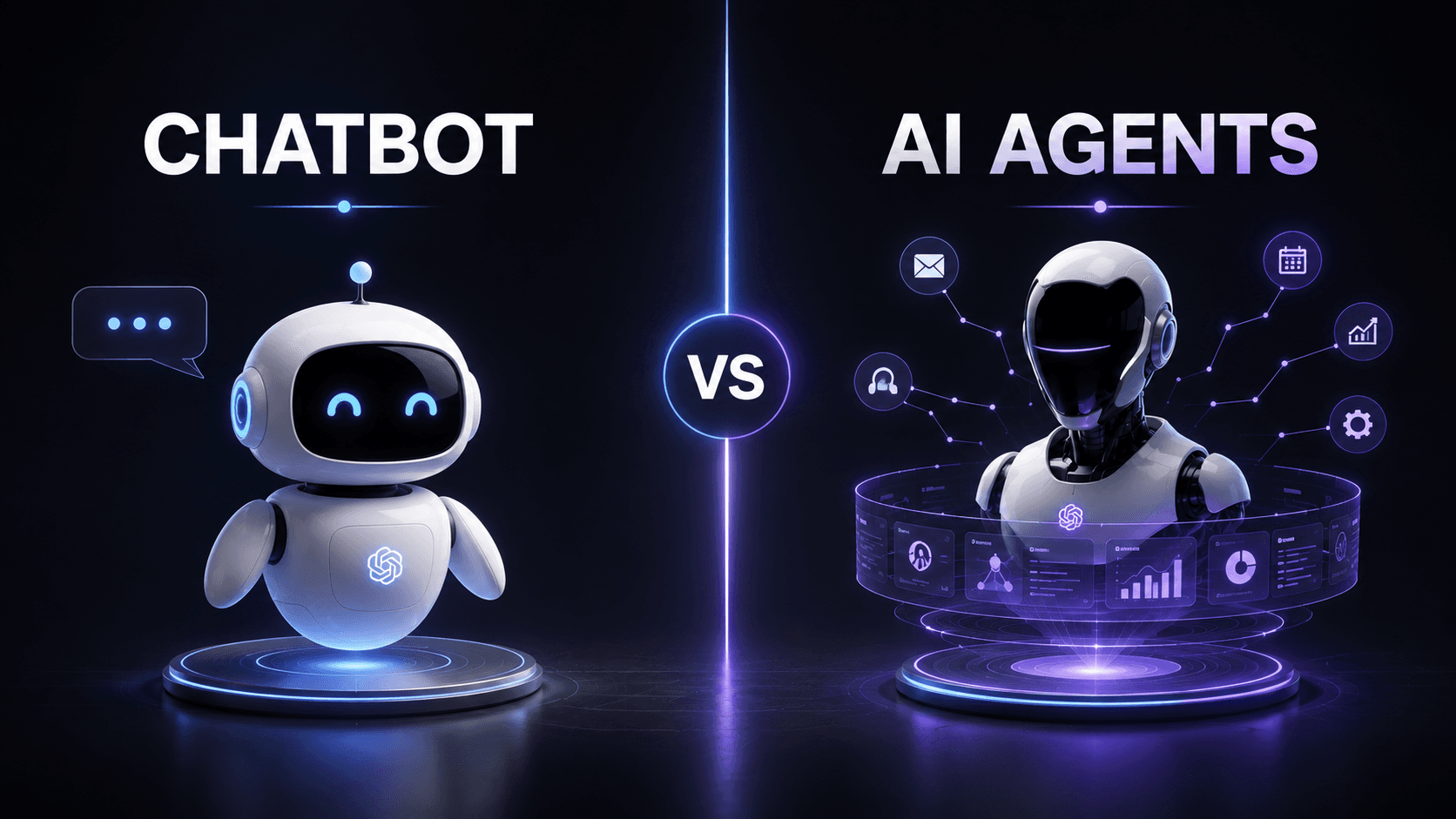
Artificial intelligence (AI) is becoming increasingly integral to how businesses and individuals interact with technology. Among its many applications, chatbots and AI agents stand out as essential tools for automation and efficiency. While these terms are often used interchangeably, they serve distinct purposes. This article explores their differences, similarities, and practical applications to help you determine the right solution for your needs.
What is a Chatbot?
A chatbot is a software application designed to simulate human-like conversations using text or voice. Introduced in the 1960s with programs like ELIZA, chatbots have evolved significantly. Today, they leverage natural language processing (NLP) and machine learning to perform basic tasks and answer common questions.
Features of Chatbots
Rule-Based Operations — chatbots often rely on predefined rules or scripts to generate responses.
Limited Scope — they typically handle specific tasks like answering FAQs or guiding users through simple workflows.
Ease of Deployment — chatbots can be integrated into websites, apps, and messaging platforms quickly and cost-effectively.
Examples of Chatbot Use Cases
Customer Support — chatbots help users track orders, process returns, and resolve basic queries.
Reservations — restaurants use chatbots to book tables by collecting details like date, time, and party size.
Learning Tools — Duolingo Max uses chatbots for language practice and explanations.
What is an AI Agent?
AI agents are more advanced systems capable of performing complex tasks and making decisions independently. Unlike simple chatbots, these systems use sophisticated AI technologies, including machine learning, deep neural networks, and reinforcement learning, to adapt dynamically to new situations, schedule multi-step processes, and coordinate with other tools.
Features of AI Agents
High Autonomy — they run continuously and make independent decisions based on changing environmental feedback to reach a set goal.
Contextual Adaptability — they dynamically adjust their workflow when encountering unexpected inputs or obstacles.
Tool Integration — they can query databases, call APIs, send emails, and execute scripts to perform actions rather than just chat.
Examples of AI Agent Use Cases
Autonomous Sales Operations — sourcing, qualifying, and engaging leads, and executing calendar bookings entirely without human supervision.
Intelligent Document Parsing — ingesting unstructured documents, confirming compliance, writing data logs, and updating accounting software dynamically.
Advanced IT Infrastructure Management — observing networks, automatically diagnosing alerts, deploying software hotfixes, and documenting resolution tickets.
Key Differences Summarized
Decision-Making — chatbots follow strict predefined paths and scripts; AI agents employ reasoning frameworks to choose optimal actions.
Autonomy & Initiative — chatbots are reactive (wait for user input); AI agents are proactive (can trigger actions based on schedules, events, or self-set goals).
Complexity & Moat — chatbots automate simple conversational loops; AI agents perform multi-step, multi-system enterprise operations.
Conclusion
Understanding whether your organization requires a chatbot or an AI agent depends entirely on the complexity of the tasks you aim to automate. While chatbots provide excellent, fast, and budget-friendly support for simple client relations, AI agents build a defensive workflow moat for complex operations. Analyze your friction points, consult our experts, and select the system that moves your business forward.
About the Author: